
How can global brands master the omnichannel customer journey?
Last updated
22 Sep
2025
By
Steffin Abraham
Duration
x
min
Published on
22 Sep 2021
By
Lynn Klemke


Large businesses master the omnichannel customer journey by using a Digital Asset Management (DAM) system as a single source of truth. This centralized hub allows teams to automate the localization, adaptation, and delivery of visual assets across all digital and physical touchpoints simultaneously. By aligning content with real-time user context, global brands ensure a seamless and consistent customer experience.
The Nonlinear Path of the Modern Customer Journey
The modern customer journey has undergone a profound transformation. For decades, consumers relied on a limited selection of channels for research and purchases. Traditional touchpoints like print, direct mail, and broadcast television defined the experience.
Today, the number of available channels has grown significantly and the way they interact has fundamentally shifted. Modern journeys are complex and customer-centric. Global brands must now manage an average of six channels across multiple devices to reach a single individual.
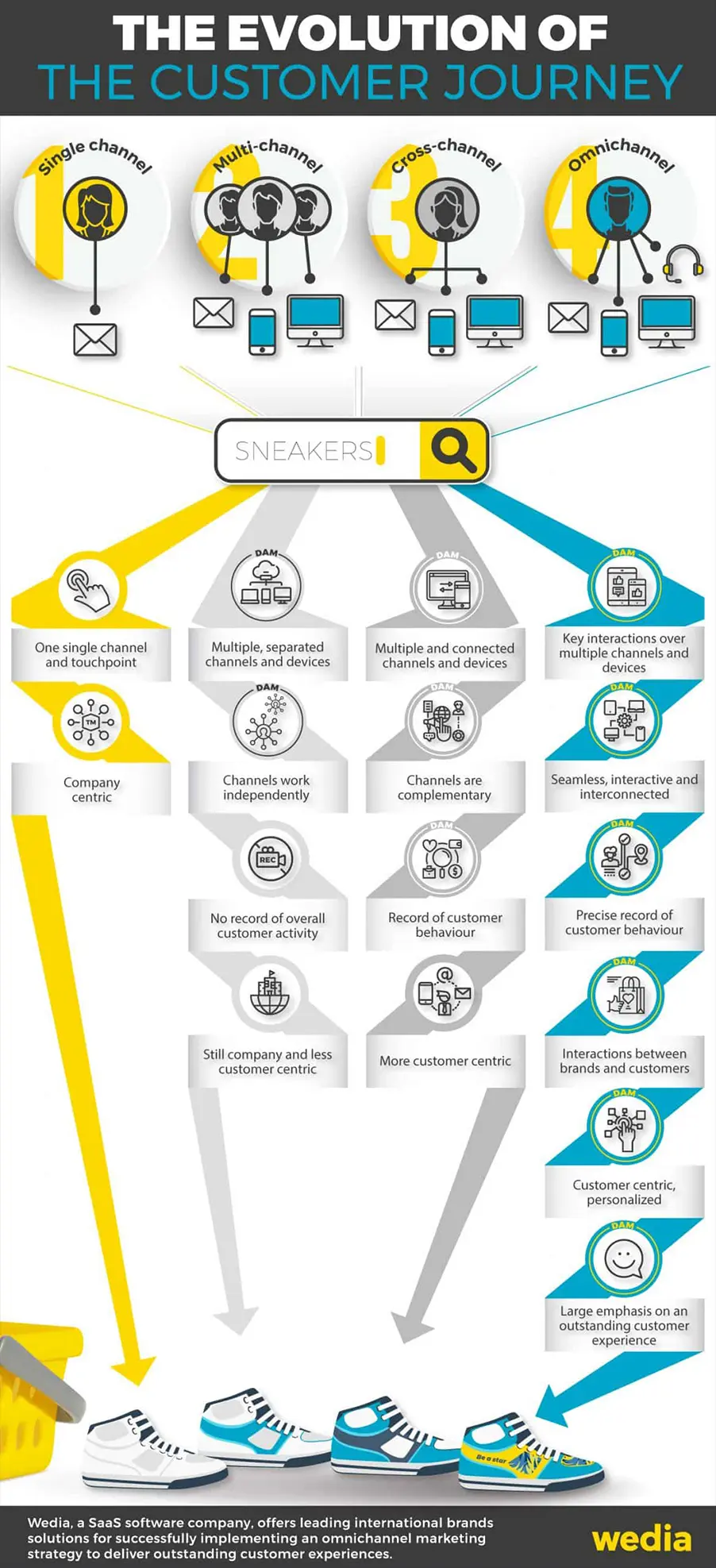
Discover our infographic on the evolution of the customer journey to see how these dynamics have shifted. To maintain authority, large-scale businesses must find out how you can master the omnichannel customer journey with a DAM to provide an outstanding customer journey, create engagement and boost sales.
Actionable Takeaway: Audit your current touchpoints to identify where siloes are preventing a unified brand narrative.
From Single to Omni: Mapping the Evolution
Digital transformation has pushed marketing strategies from linear paths to interconnected ecosystems. Understanding the distinction between these engagement models is critical for CPG and retail leaders who need to scale their operations.
Single-Channel: The Legacy Model
The single-channel approach represents the traditional retail environment. It relies on one touchpoint, such as a brick-and-mortar store or a catalog. While this model is company-centric and simple to manage, it lacks the personalization required by modern consumers.
It can make sense when financial and human resources are limited. However, it often results in missing selling opportunities and a failure to capture vital customer behavior data.
Multi-Channel: Expanding Reach
The multi-channel strategy adopts a "don't put all your eggs in one basket" philosophy. It allows large businesses to reach customers through separate channels like a web shop, social media ads, and physical locations.
The primary challenge here is compartmentalization. Channels often work independently, making content attribution difficult. A DAM solution supports these efforts by providing a central hub for all content to ensure brand safety and coherence.
Cross-Channel: Connecting the Experience
Cross-channel marketing connects various platforms to offer a smoother experience. A customer might discover a product on TikTok, receive a promo code via email, and pick up the item in-store.
This "phygital" approach allows brands to collect more sophisticated data. You can achieve this level of integration when you are using the right tools for data collection like Wedia’s marketing solutions.
Omnichannel: The Unified Standard
Omnichannel represents the pinnacle of modern engagement. It places the customer at the center of a seamless, interactive, and interconnected experience. It accounts for ubiquity, such as a customer using their smartphone to compare reviews while standing in a physical aisle.
Actionable Takeaway: Transition from multi-channel to omnichannel by ensuring that data from one touchpoint immediately informs the experience on the next.
Content Scaling as the Engine of Omnichannel Success
Handling content at scale is the greatest hurdle in an omnichannel strategy. Every asset must be contextualized, adapted, and personalized for various global markets while maintaining strict brand guidelines.
Global brands require powerful tools to manage this complexity. Lyvio’s Media Delivery and Digital Experience module helps you tackle these challenges by analyzing how your existing channels perform. This allows you to track engagement and sales precisely to adapt your strategy in real time.
By empowering both online and offline channels, you can provide superior phygital shopping experiences. The Lyvio’s Media Delivery and Digital Experience module is the ideal combination to your DAM solution and very easy to integrate in your existing MarTech stack.
Wedia, a SaaS software company, provides the infrastructure necessary for multinational organizations to deliver these high-impact journeys at scale.
Actionable Takeaway: Use AI-driven localization to automatically adapt your core assets for regional markets without increasing manual design overhead.
Key Takeaways
- Omnichannel marketing places the individual at the center of an interactive, ubiquitous brand experience.
- Digital Asset Management systems act as the essential engine for scaling localized content globally.
- Phygital experiences bridge the gap between physical retail and digital layers through real-time connectivity.
- Data-driven content scoring allows brands to optimize asset performance across every active distribution channel.
- Consistency across all touchpoints is mandatory to maintain brand integrity in a nonlinear journey.
Frequently Asked Questions
Q: What is the difference between multichannel and omnichannel marketing?A: Multichannel marketing uses several independent channels to reach customers, while omnichannel integrates those channels into a single, seamless experience. In an omnichannel model, the customer journey is connected so that an action on one device informs the interaction on another.
Q: How does a DAM help in an omnichannel strategy?A: A DAM serves as a single source of truth for all digital assets, ensuring that only approved and current versions are used. It automates the adaptation of assets for different formats and regions, which is essential for maintaining consistency across hundreds of touchpoints.
Q: Why is the customer journey becoming more complex in 2026?A: The proliferation of AI assistants, spatial computing, and social commerce has created more non-linear touchpoints. Consumers now expect brands to recognize their preferences instantly, regardless of the channel or device they are using.
Q: What are phygital shopping experiences?A: Phygital experiences blend physical retail environments with digital functionality. Examples include using AR in-store to see product details or using a mobile app to trigger personalized offers while browsing physical shelves.
Q: How can large businesses ensure brand consistency globally?A: Global organizations use customizable DAM platforms to lock core brand elements while allowing local teams to adapt specific text and imagery. This "glocal" approach ensures brand integrity while remaining relevant to local cultural contexts.
Q: What role does AI play in the modern customer journey?A: AI powers hyper-personalization by analyzing vast datasets to deliver the right content at the right time. It also automates tedious tasks like metadata tagging and background removal, allowing creative teams to focus on strategy.
Q: Can a DAM help measure marketing ROI?A: Yes, advanced DAM systems include content scoring and tracking features. These tools show which assets drive the most engagement and conversions, allowing leaders to make data-driven investment decisions.
Q: Is a single-channel approach still viable for large brands?A: Generally, no. While single-channel models are simpler, they cannot meet the expectations of the modern consumer. Large businesses require a presence across multiple interconnected channels to remain competitive and capture market share.
Bottom Line
The evolution from single-channel to omnichannel marketing requires a strategic shift toward centralized content management and AI-powered localization. By utilizing a DAM as a single source of truth, global brands can deliver personalized, consistent, and high-performing customer journeys across all touchpoints.
Call to Action
See how Lyvio helps global brands solve the challenges of content scaling and omnichannel delivery. Book a personalized strategic consultation.
Articles you may find interesting


Get more marketing tips
& news straight to your inbox


Wedia’s Digital Asset Management journey began in 2010.
Through Lyvio, its AI-native DAM platform, Wedia is part of the Top 10 DAM vendors worldwide, the Top 5 in Europe, and Number 1 in France.


