
What's the carbon footprint of your digital assets?
Last updated
12 Oct
2025
By
Steffin Abraham
Duration
x
min
Published on
12 Oct 2023
By
Louise McNutt


We know that climate change and its environmental implications are a pressing concern for many across the planet. Indeed people in Taiwan (80%), Italy (75%), France (74%), Spain (73%), South Korea (71%) and Japan (70%) see climate change as a very serious problem.
Subsequently companies across the world have begun to incorporate climate actions into their Corporate Social Responsibility (CSR) strategies, carrying out a number of initiatives which look to reduce their carbon footprint.
As businesses and individuals work to understand their impact and address how they can make changes, one area which is often overlooked is the impact of digital technologies. Whilst a number of new technologies has been created to help reduce our physical carbon footprint, the reliance on extra storage, electricity and infrastructure is not without its own environmental impact.
From everyday actions like sending an email to using cloud storage, in this infographic we look at the real consequences on our planet that these digital tools can have.
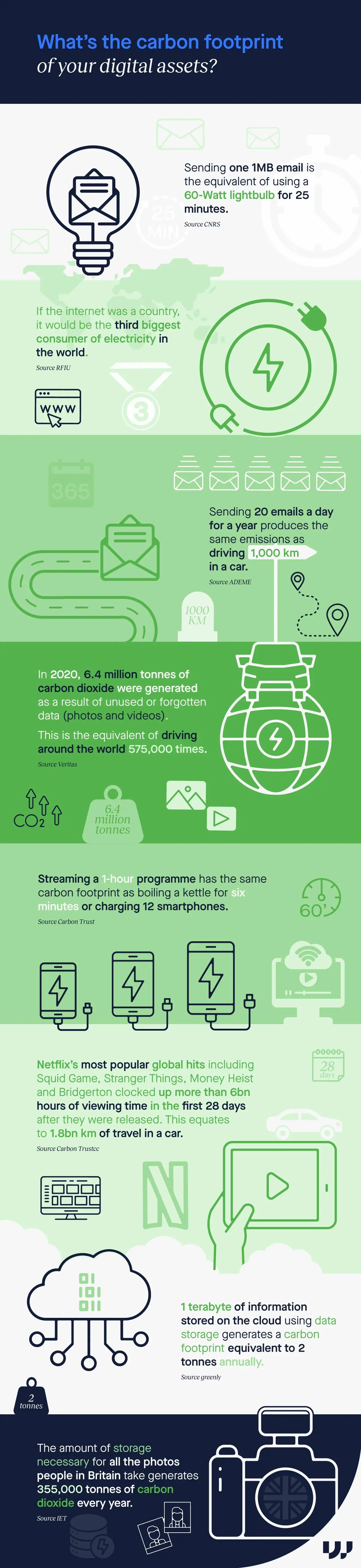
Considering the environmental effects caused by digital technology is still relatively new and we must learn how to balance the positive changes that tools such as Artificial Intelligence (AI) and data can have for us versus the damage they can do.
Software such as a Digital Asset Management (DAM) system can help large organisations reduce their carbon footprint through removing duplicates, streamlining their publishing processes and monitoring their activities to ensure they aren’t creating unnecessary content that doesn’t appeal to their audiences.
Frequently Asked Questions
Q: What is the environmental impact of digital technology?
A: The environmental impact of digital technology encompasses the energy consumed by data centers, networks, and connected devices. This digital infrastructure generates significant greenhouse gas emissions worldwide.
Q: How can multinational organizations reduce their digital carbon footprint?
A: Organizations can limit digital emissions by auditing cloud storage, deleting duplicate files, and optimizing media delivery. Using a centralized platform ensures efficient content reuse and lowers energy demands.
Q: Why does data storage affect the environment?
A: Servers require continuous electricity to process data and run high-powered cooling systems. Storing millions of unused marketing assets directly increases energy consumption and carbon emissions.
Q: How does a DAM system improve digital sustainability?
A: A Digital Asset Management solution consolidates media, identifies duplicates, and tracks asset performance. This prevents unnecessary content production and significantly lowers server storage requirements.
Q: Does Artificial Intelligence increase digital pollution?
A: Yes, AI requires vast computational power and energy to train models and generate content. Brands must balance AI usage with sustainable storage and strategic asset distribution practices.
Q: What role does digital sustainability play in CSR strategies?
A: Modern CSR strategies must account for both physical and digital emissions to be effective. Addressing digital sustainability demonstrates a brand's authentic commitment to holistic environmental responsibility.
Q: How can marketers align their campaigns with eco-friendly practices?
A: Marketers can adopt sustainable practices by repurposing existing assets instead of constantly producing new ones. Analyzing content performance ensures teams only distribute high-value materials.
Bottom Line
Understanding the environmental impact of digital technology is the first crucial step toward a sustainable marketing strategy. By consolidating media and eliminating waste, global brands can dramatically reduce their digital carbon footprint. Lyvio provides the structural foundation to make eco-friendly content management a reality.
See how Lyvio helps global brands solve digital content sprawl and reduce their carbon footprint. Book a personalized demo.
Articles you may find interesting


Get more marketing tips
& news straight to your inbox


Wedia’s Digital Asset Management journey began in 2010.
Through Lyvio, its AI-native DAM platform, Wedia is part of the Top 10 DAM vendors worldwide, the Top 5 in Europe, and Number 1 in France.


